Mainstream email infrastructure relies primarily on transport-layer encryption via Transport Layer Security (TLS) to secure data in transit. While TLS effectively prevents passive eavesdropping between mail servers, it leaves emails exposed in plaintext or symmetrically encrypted under server-controlled keys once they reach a mail provider’s infrastructure.
Tuta (historically known as Tutanota) addresses this structural vulnerability by implementing a client-side, zero-knowledge end-to-end encrypted (E2EE) architecture. By executing all cryptographic operations directly on the user’s local device before data transmission, the underlying server infrastructure functions strictly as an untrusted storage and routing layer.
The Zero-Knowledge Authentication Flow
To eliminate the systemic risk of server-side data exposure, Tuta ensures the account password never traverses the network in plaintext. Instead, it utilizes a client-side derivation process to decouple user authentication from data decryption.
[Plaintext Password]
         │
         ▼
    [Argon2 KDF] ───► Generates 256-bit AES Password Key ──► Decrypts Local Private Key
         │
         ▼
   [SHA-256 Hash]
         │
         ▼
[Password Verifier] ───(TLS Tunnel)───► [Tuta Authentication Server]
- Client-Side Key Derivation: When a user inputs their password, the local client processes it using Argon2 combined with a unique salt. This outputs a 256-bit symmetric key known as the AES Password Key.
- Decoupling the Authenticator: The local client hashes the AES Password Key using SHA-256 to generate a separate string: the Password Verifier.
- Server Verification: The Password Verifier is transmitted to the Tuta server over a TLS-encrypted session. The server validates this string against a mathematically transformed database record (a hashed verifier).
Because the Password Verifier is cryptographically distinct from the AES Password Key, an adversary compromising the server database cannot reverse-engineer the key required to decrypt the user’s stored data.
Hybrid Asymmetric Cryptography: Migrating to Post-Quantum
Tuta does not utilize standard Pretty Good Privacy (PGP). The engineering team rejected PGP due to structural limitations: its inability to encrypt email subject lines natively, its lack of Perfect Forward Secrecy (PFS), and the friction involved in upgrading its underlying algorithms.
Historically, Tuta utilized a classical hybrid architecture combining AES-256 for symmetric data encryption and RSA-2048 for asymmetric key exchange. However, to mitigate the threat of harvest-now-decrypt-later attacks by future quantum computers running Shor’s algorithm, Tuta deployed its proprietary protocol: TutaCrypt.
TutaCrypt mandates a dual-layered hybrid asymmetric mechanism for account communications, operating with two parallel key pairs:
- Classical Layer: An Elliptic Curve Key Pair utilizing the X25519 curve for standard Elliptic Curve Diffie-Hellman (ECDH) key exchanges.
- Post-Quantum Layer: A Kyber-1024 Key Pair implementing quantum-resistant key encapsulation via the CRYSTALS-Kyber algorithm.
The Asymmetric Handshake Protocol
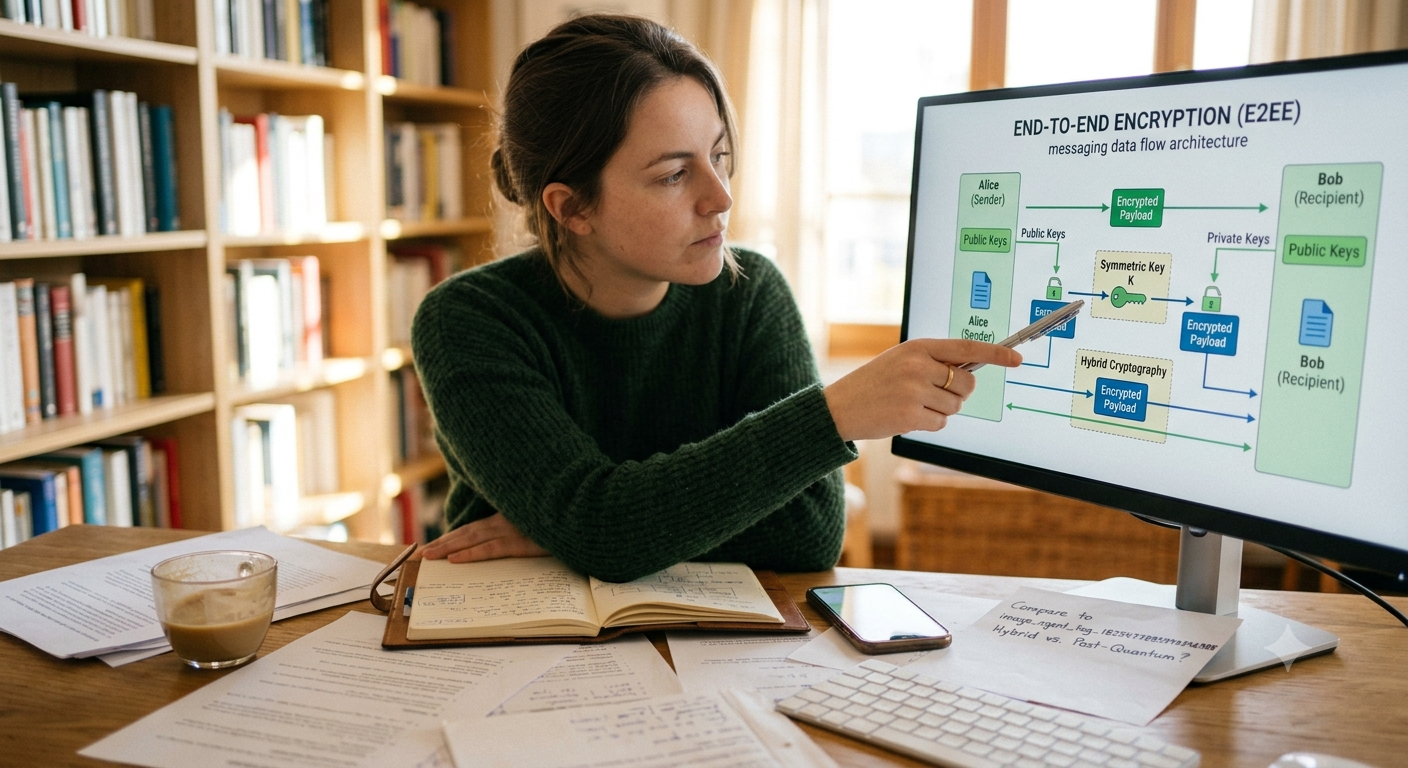
When Alice transmits an encrypted email to Bob within the ecosystem, the following cryptographic sequence occurs:
- Key Retrieval: Alice’s client fetches Bob’s public identity keys from the Tuta keyserver: his classical curve public key ($IK_{B\_ECC}$) and his post-quantum public key ($IK_{B\_PQ}$).
- Ephemeral Generation: Alice’s client generates its own ephemeral X25519 key pair ($EK_{A\_ECC}$).
- Shared Secret Generation ($SS_{PQ}$): Alice’s client passes Bob’s public post-quantum key ($IK_{B\_PQ}$) into the Kyber encapsulation algorithm ($PQEnc$), outputting a post-quantum shared secret ($SS_{PQ}$) and a corresponding ciphertext ($CT_{PQ}$).
- Classical Secret Generation ($SS_{CC}$): Alice’s client executes a standard Diffie-Hellman exchange using her ephemeral private key and Bob’s public key ($IK_{B\_ECC}$), establishing a classical shared secret ($SS_{CC}$).
- Key Derivation Function (KDF): Both secrets are concatenated and fed into an HKDF-SHA-256 function alongside context strings to isolate domains:
$$K_{master} = \text{HKDF}(SS_{CC} \mathbin{\Vert} SS_{PQ}, \text{salt}, \text{info})$$
This master key material derives the Key Encryption Key (KEK). The payload itself is encrypted using a randomly generated symmetric Bucket Key (BK) via AES-256 in CBC mode paired with HMAC-SHA-256 (Encrypt-then-MAC). The KEK is then used to securely encapsulate the Bucket Key, and the payload, ciphertexts, and encrypted keys are bundled into a standardized payload sent to the server.
Expanding the Encrypted State: Metadata, Search, and Calendars
A distinct feature of Tuta’s architecture is its comprehensive encryption of data structures that traditional secure mail providers leave unencrypted.
Blind Search Indexes
To allow search functionality without server-side index processing, Tuta builds a local search index on the client device. When new messages are received and decrypted locally, the client parses the text, tokens are extracted, and a search index is constructed. This index is symmetrically encrypted using a dedicated local key and uploaded back to the server as a binary blob. When a search query is executed, the client downloads the encrypted blob, decrypts it into memory, and performs the query execution locally.
Zero-Knowledge Calendars & Notifications
Tuta’s calendar module extends end-to-end encryption to event metadata, including titles, descriptions, locations, and attendee lists.
[Client Calendar Event] ──► Encrypt Event Body & Metadata (AES-256)
                        ──► Obfuscate Notification Time Vector
                        ──► Send Encrypted Payload to Server
To handle push notification reminders without leaking event times to the server, the client uses an obfuscated scheduling mechanism. The exact timing vectors of notification alarms are mathematically masked before being synced to the server infrastructure, preventing the host from aggregating behavioral or scheduling timelines of its user base.
Infrastructure Hardening & Protocol Security
The application layer sits atop a strictly managed physical environment. Tuta owns and operates its server hardware housed within data centers in Germany, avoiding third-party public cloud compute nodes.
At the protocol layer, the infrastructure implements advanced security policies to harden standard email transport:
- MTA-STS (Mail Transfer Agent Strict Transport Security): Enforces a strict policy requiring external mail servers to establish high-grade TLS tunnels before transmitting data to Tuta’s MX hosts, mitigating down-grade and man-in-the-middle (MITM) attacks.
- DANE (DNS-based Authentication of Named Entities): Binds TLS certificates directly to DNS records using DNSSEC, preventing rogue certificate authorities from issuing valid certificates for Tuta’s domains.
By combining client-controlled post-quantum key encapsulation with a strict zero-knowledge architecture, the platform maintains systemic cryptographic isolation from the infrastructure that hosts it.
Source: Tuta Mail: Create a secure, private & encrypted email account for free