The automotive landscape is undergoing a massive paradigm shift. Vehicles are no longer just mechanical instruments designed to get us from point A to point B; they have transformed into highly sophisticated, interconnected digital ecosystems. At the absolute forefront of this technological revolution is Kia.
Through its flagship Kia Connect ecosystem (including the newly deployed Kia Connect 2.0 and the Connected Car Navigation Cockpit – ccNC), Kia has fundamentally redefined what drivers expect from an infotainment and navigation suite. This comprehensive breakdown explores the underlying mechanics, convenience features, safety implementations, and electric vehicle optimizations of Kia’s navigation ecosystem.
The Evolution of the Connected Car Navigation Cockpit (ccNC)
Historically, in-car navigation systems were notoriously clunky, relying on localized SD card maps that quickly fell out of date. Kia bypassed these legacy limitations by introducing its next-generation unified cockpit architecture.
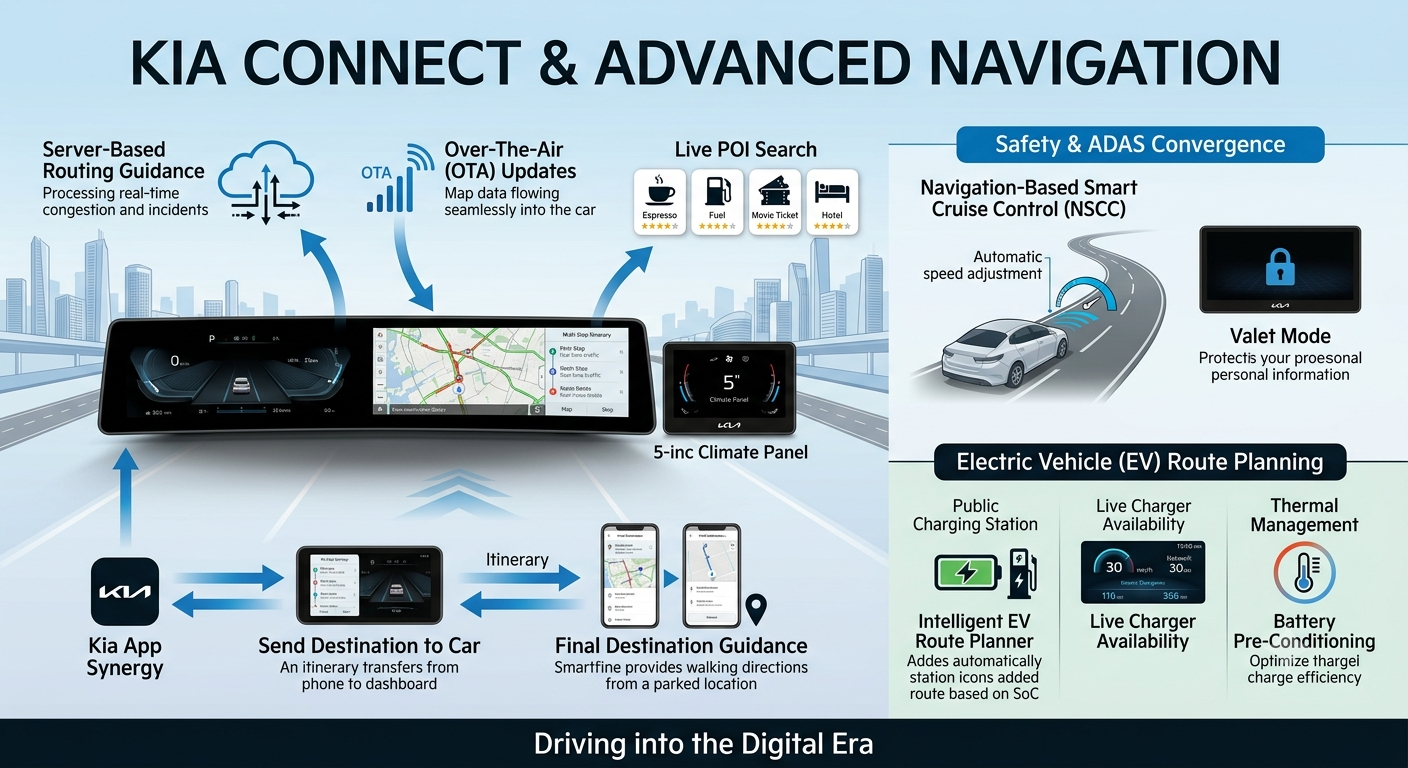
The centerpiece of modern flagships like the Kia EV9 and top-tier trims of the Kia Seltos is a striking, panoramic multi-display system. It fuses a 12.3-inch digital instrument cluster, a 5-inch dedicated climate panel, and a 12.3-inch touchscreen infotainment interface into one continuous, high-definition curved panel. This hardware operates on an entirely refreshed graphical user interface (GUI) designed specifically to reduce driver distraction by organizing menus intuitively and displaying critical map geometry directly in the driver’s peripheral line of sight.
Core Pillars of Kia’s Cloud-Based Navigation
Kia’s proprietary navigation does not just sit passively inside the dashboard; it actively leverages high-speed cellular telemetry to tap into server-side cloud databases. This yields several high-value performance advantages:
1. Server-Based Routing Guidance
Traditional onboard navigation processors calculate routes using historical static data. Kia’s server-based routing continuously computes traffic models via cloud servers. By processing real-time congestion data, upcoming road incidents, and regional choke points simultaneously, the system delivers hyper-accurate Estimated Times of Arrival (ETAs) and dynamically shifts the active route to bypass gridlock before the driver ever encounters it.
2. Over-The-Air (OTA) Map and Software Updates
The days of visiting a dealership or plugging a USB flash drive into a computer to update maps are gone. Kia’s ecosystem utilizes automatic background OTA updates. These updates refresh highway infrastructure, geometry configurations, street names, and software patches directly over cellular networks, ensuring the vehicle’s maps remain perfectly current.
3. Hyper-Local Live POI Search
Looking for a quick espresso, a specific brand of fuel station, an atmospheric multiplex, or an available hotel? The integrated search infrastructure parses live, crowdsourced local business databases rather than relying on stale pre-installed lists. Drivers receive instantaneous operating hours, community ratings, and exact entry coordinates.
Seamless Integration: The Mobile App Synergy
True connectivity means your vehicle remains accessible even when parked in a basement garage miles away. The companion Kia App establishes a secure, encrypted link between the driver’s smartphone and the vehicle’s onboard computer.
[Smartphone App] ----(Cloud Telemetry)----> [Kia Onboard Server] ----> [Car Executes Command]
- Send Destination to Car: Users can plan a complex weekend road trip on their phone from the comfort of their couch, pre-program the stops, and send the entire multi-stop itinerary straight to the car’s screen instantly.
- Set Destination with Schedule: Syncing the smartphone calendar with Kia Connect allows the navigation system to automatically pre-load the route to an upcoming corporate meeting or dinner reservation the moment the driver presses the engine start button.
- Final Destination Guidance: If parking is unavailable directly at the final destination, the car’s screen safely passes the remaining walking coordinates over to the driver’s phone, providing step-by-step pedestrian navigation to the exact doorstep.
- Live Car Tracking and Spatial Sharing: Users can monitor their vehicle’s real-time physical location on a smartphone map or securely broadcast their live trip progress, location tracking, and remaining arrival time to loved ones.
Safety, Smart ADAS, and Navigation Convergence
Kia’s navigation system is a core sensor inputs stream for the vehicle’s Advanced Driver Assistance Systems (ADAS). By intertwining GPS spatial awareness with active safety radars and cameras, the vehicle gains predictive capability:
Navigation-Based Smart Cruise Control (NSCC)
Standard cruise control maintains speed blindly regardless of upcoming terrain. Kia’s NSCC utilizes live navigation data to interpret road geometry ahead. If the vehicle is approaching a sharp curve, a major highway junction, or a designated speed zone, the onboard system automatically and smoothly reduces speed to safe cornering thresholds, accelerating back up to the preset cruise target once the road straightens out.
High-Tier Valet and Security Protections
When handing keys over to a valet driver, owners can activate Valet Mode on their app. This locks the main infotainment screen, protects personal address books, and actively reports the vehicle’s location coordinates, driving duration, top speed, and distance traveled back to the user’s smartphone.
Dedicated Electric Vehicle (EV) Route Planning
For owners of electric vehicles like the Kia EV6 or EV9, the cloud navigation system eliminates “range anxiety” via structural automation.
| Feature | Functionality | Driver Benefit |
| Intelligent EV Route Planner | Constantly monitors battery state of charge (SoC) along an active route. | Automatically injects public charging stations into the itinerary if the current charge cannot reach the destination. |
| Live Charger Availability | Displays live occupancy, charging speeds (kW), and network provider details. | Prevents drivers from pulling up to broken or occupied charging stalls. |
| Battery Pre-Conditioning | Coordinates thermal systems with the navigation timeline. | WARMS or COOLS the battery pack automatically as the car approaches a high-speed DC fast charger to maximize peak charging efficiency from the moment it is plugged in. |
Conclusion: Driving Forward
Kia’s commitment to building a cutting-edge navigation architecture proves that modern engineering is measured as much by software prowess as it is by horsepower. By seamlessly blending server-based routing, intuitive user design, proactive ADAS safety networks, and smart phone ecosystems, Kia delivers a stress-free driving experience that genuinely moves at the speed of life.
Also Read: The Critical Benefits of Adopting 1Password for Digital Identity Management – My Tech Blaze