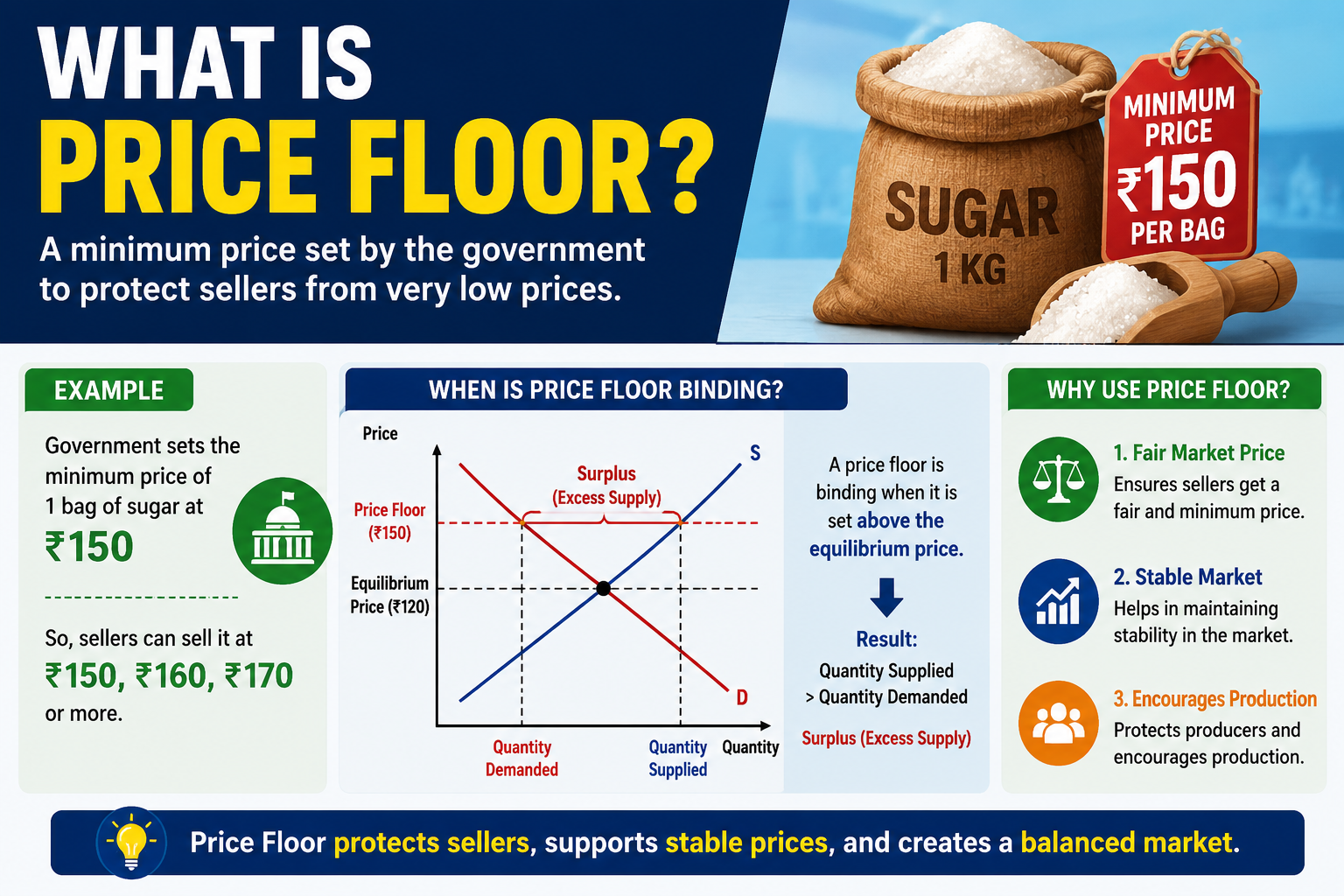
A price floor is the minimum legal price at which a good or service can be sold. It is set by the government to protect producers or sellers from receiving very low prices.
Example:
Suppose the government sets a minimum price of ₹150 per bag of sugar. Sellers are not allowed to sell below ₹150, but they can sell at ₹150, ₹160, ₹170, or any higher price.
When is the price floor binding?
A price floor is binding when it is set above the market equilibrium price. In this case:
- Sellers cannot legally sell below the price floor.
- The quantity supplied becomes greater than the quantity demanded.
- This creates a surplus (excess supply) in the market.
Why is a price floor used?
- To protect producers from very low prices.
- To ensure a fair and stable market price.
- To encourage production and provide producers with a reasonable income.
Example of a binding price floor
- Equilibrium price = ₹120 per bag
- Government price floor = ₹150 per bag
Since ₹150 > ₹120, the price floor is binding. Consumers buy less at ₹150, while producers supply more, resulting in a surplus.
Suggestion for your original answer:
- Replace “guidelines” with minimum legal price.
- Don’t say it helps “everyone buy easily.” A binding price floor usually makes goods more expensive, so consumers may buy less, not more.
- Be sure to mention the condition for a binding price floor: Price floor > Equilibrium price.
This version would be suitable for a Class 11 or Class 12 economics exam and is likely to earn full marks.