1. System Core Architecture and Kernel Evolution
The architectural backbone of iDrive has undergone a fundamental shift in its underlying operating system (OS) kernel.
Linux vs. Android Open Source Project (AOSP)
For generations, including iDrive 8.5, BMW relied on a proprietary Linux-based software stack. Linux offered deterministic stability and deep control over hardware abstraction layers (HAL), but it lacked a rapid, scalable app ecosystem.
With iDrive 9 and the newer Operating System X, BMW transitioned to an Android Open Source Project (AOSP) software stack. This architectural pivot provides a decoupled app layer, enabling over-the-air (OTA) deployments of third-party apps (streaming, gaming, and productivity) without altering core vehicle control code.
The Hypervisor Architecture
To preserve functional safety standard ISO 26262 requirements, infotainment processes must never interfere with critical driving functions (such as powertrain or driver assistance). BMW utilizes a Type-1 hypervisor (typically QNX Neutrino) to partition the hardware memory. The open AOSP subsystem runs in a secure virtual machine (VM) entirely isolated from the real-time operating system (RTOS) managing vehicle safety dynamics.
2. Bus Systems and Data Processing Pipeline
An infotainment system is only as fast as its data pipeline. Modern iDrive communicates across a highly complex, high-bandwidth vehicle network topology.
- Automotive Ethernet (100BASE-T1 / 1000BASE-T1): The primary spine connecting the Head Unit to the Central Computing Clusters and Advanced Driver Assistance Systems (ADAS). Operating at speeds up to $1\text{ Gbps}$, it ensures lag-free telemetry streaming and instant rendering of high-definition maps.
- Controller Area Network Flexible Data-Rate (CAN-FD): Used for fast, deterministic control messages between iDrive inputs (such as haptic steering wheel controls or the classic iDrive rotary dial) and the body domain controllers.
- API Streaming & Graphics Pipeline: Graphics rendering is offloaded to a high-performance system-on-chip (SoC), primarily leveraging Qualcomm Snapdragon Automotive cockpits. The SoC runs hardware-accelerated OpenGL ES or Vulkan APIs to drive multi-display layouts without frame drops, maintaining a consistent $60\text{ Hz}$ refresh rate.
3. The HMI Philosophy: “QuickSelect” and Layer Depth
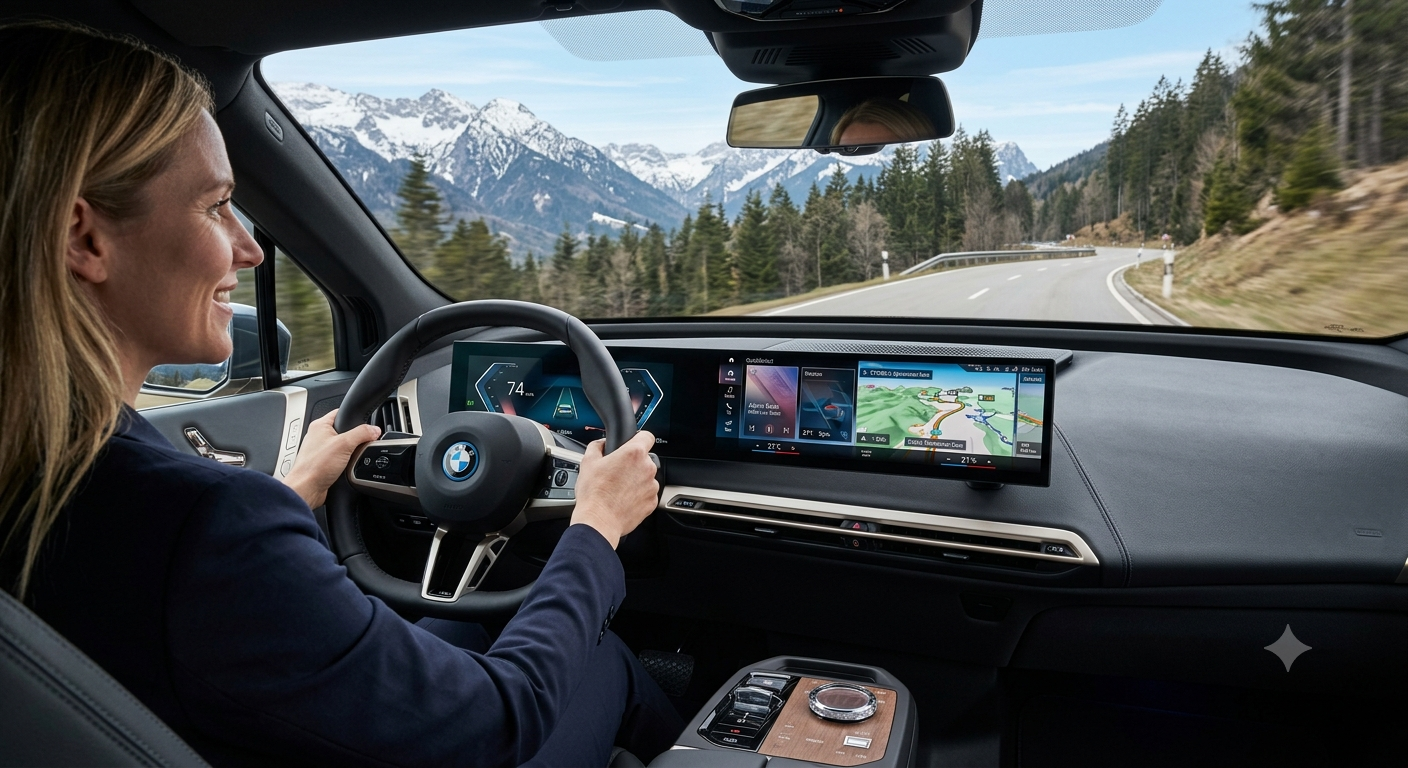
A major engineering challenge of modern touch-driven automotive UI is driver distraction caused by menu diving. BMW solved this in OS 8.5 and 9 via the QuickSelect concept.
Technically, QuickSelect implements a zero-layer HMI pattern. Rather than traditional nested tree menus, the home screen is a permanently viewable map interface overlaid with dynamic vertical widgets.
The graphics pipeline reserves dedicated screen real estate for the climate control tray and core shortcuts, meaning high-frequency functions can be triggered with a single, direct interrupt signal rather than traversing multiple submenus.
4. Next-Gen Display Orchestration: OS X and Neue Klasse
With the introduction of BMW Operating System X, the physical display topology moves past the standard curved dashboard screen. The HMI is divided into a synchronized four-component ecosystem:
BMW Panoramic Vision
Unlike a traditional Head-Up Display (HUD) with a narrow field of view, Panoramic Vision uses a highly reflective dark coating along the lower edge of the windshield. A matrix-backlight projection unit embedded in the dashboard projects high-contrast, sharp telemetry across the full width of the driver’s sightline. It operates as an unsegmented display zone, visible to both driver and passenger.
Matrix Backlight Central Display
The central screen utilizes active matrix backlight technology, optimizing the local dimming zones to achieve deep blacks and vibrant colors under harsh ambient sunlight. This ensures the UI elements remain perfectly legible without requiring bulky anti-glare shrouds.
3D Head-Up Display
For dynamic driving feedback, an optional 3D HUD projects information directly into the driver’s focal line of sight. It relies on stereoscopic parallax generation to overlay augmented-reality (AR) arrows exactly onto the physical road lanes for navigation.
5. Natural Language Processing and LLM Cloud Compute
The BMW Intelligent Personal Assistant has evolved from rigid, keyword-matching grammar engines to a conversational interface.
- Hybrid Voice Processing: Simple commands (e.g., “Set temperature to 21 degrees”) are processed locally on an edge-AI embedded speech recognition engine to minimize latency and ensure off-line capability.
- Large Language Model (LLM) Integration: Complex or contextual queries (e.g., “Can I take a brief video call while waiting at my next charging stop?”) are tokenized, encrypted, and beamed via 5G to BMW’s cloud backend. Here, an integrated LLM parses semantic intent, checks live vehicle telematics, and returns a natural-language response.
6. Connectivity, Lifecycle Management, and Digital Premium
Modern iDrive units function as edge-computing network nodes. Equipped with dual-SIM 5G modems, the vehicle splits traffic: one pipeline is dedicated to vehicle telemetry and OTA firmware deployments (via 03/2026.xx deployment tracks), while the other handles consumer data, streaming infotainment, and localized cellular vehicle-to-everything (C-V2X) hazards.
Through the BMW Digital Premium software-as-a-service (SaaS) model, BMW utilizes an over-the-air containerized framework. It allows feature activation on demand—such as upgrading navigation engines to include real-time 3D building rendering or altering vehicle acoustics profiles via software-defined sound spaces like HypersonX—ensuring the hardware architecture remains current over its lifecycle.
Also Read: Express VPN Service For Fast And Secure Internet Browsing – My Tech Blaze
Source: BMW iDrive – Wikipedia