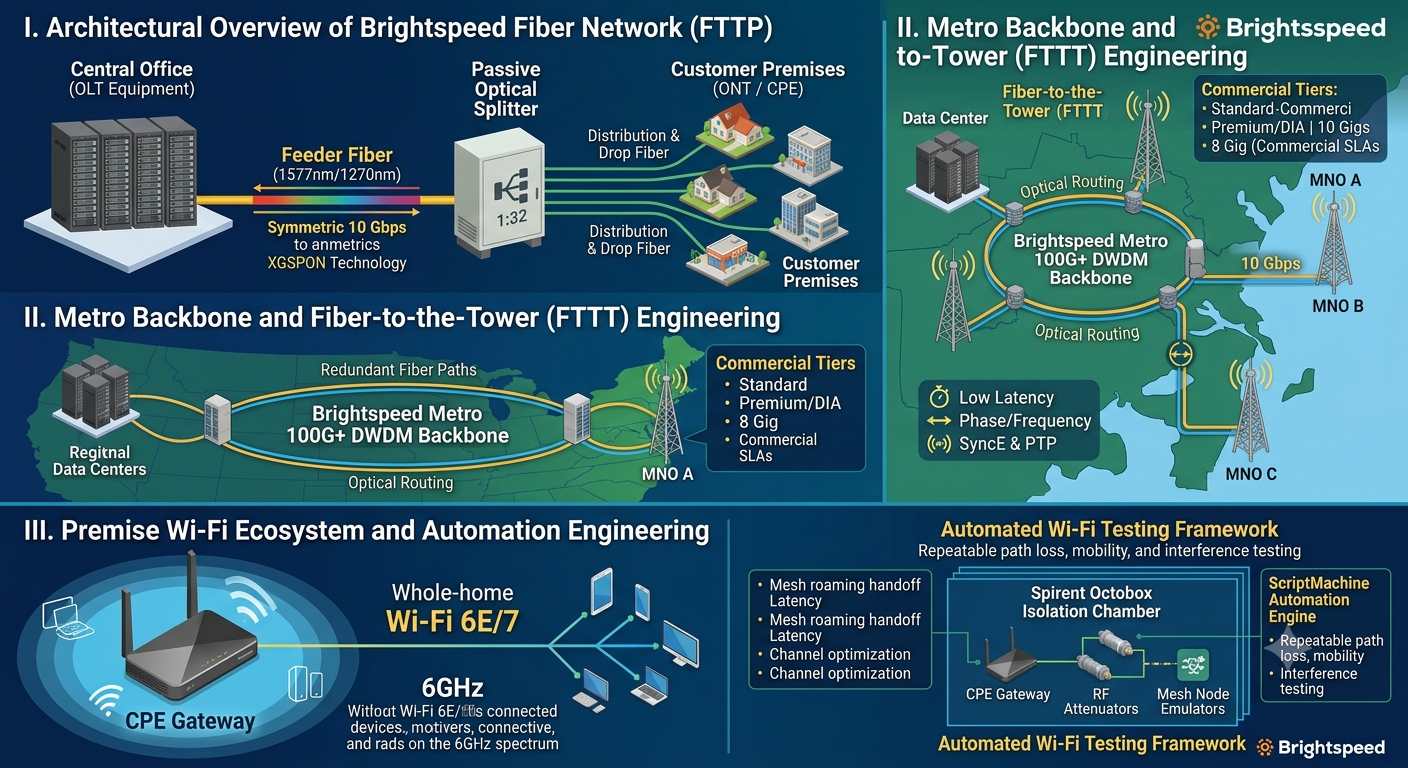
Brightspeed’s multi-billion-dollar network transformation centers on replacing legacy copper-based Digital Subscriber Line (DSL) infrastructure with Fiber-to-the-Premises (FTTP) architecture. The core design principle utilizes XGSPON (10-Gigabit Symmetric Passive Optical Network) technology, a point-to-multipoint network standard capable of delivering $10\text{ Gbps}$ of symmetrical upstream and downstream data bandwidth over a single fiber strand.
Unlike older Gigabit Passive Optical Network (GPON) deployments that feature asymmetric bandwidth profiles (typically $2.488\text{ Gbps}$ downstream and $1.244\text{ Gbps}$ upstream), XGSPON uses a single-wavelength plan operating at $1577\text{ nm}$ for downstream traffic and $1270\text{ nm}$ for upstream traffic. This choice of wavelengths permits coexistence with legacy GPON systems over the same physical Optical Distribution Network (ODN) via Coexistence Element (CE) filters, allowing a seamless migration path without requiring fiber re-trenching or re-splicing.
+------------------+     Feeder Fiber     +-----------------------+     Distribution     +--------------------+
|   Central Office |--------------------->| Passive Optical Split |--------------------->| Customer Premises  |
|   (OLT Equipment)|                      | (1:32 or 1:64 Ratio)  |     Fiber (Drop)     |    (ONT / CPE)     |
+------------------+                      +-----------------------+                      +--------------------+
The optical network layout is divided into three fundamental layers:
- Feeder Fiber: High-strand-count single-mode fiber cables routing from the Central Office (CO) Optical Line Terminal (OLT) out to localized primary convergence points.
- Optical Splitters: Passive, unpowered beam-splitters typically deployed at a $1:32$ or $1:64$ splitting ratio inside local cabinets, eliminating the need for active electronics in the field and minimizing point-of-failure vulnerabilities.
- Distribution & Drop Fiber: Individual fiber runs routing from the splitters directly into residential and commercial Customer Premises Equipment (CPE), terminating at an Optical Network Terminal (ONT).
Metro Backbone and Fiber-to-the-Tower (FTTT) Engineering
To prevent bottlenecking at the aggregation layer, Brightspeed has re-engineered its regional transport networks by establishing localized Metro Ethernet Networks (MENs). These MENs are built upon a $100\text{ Gbps}+$ transport backbone using Dense Wavelength Division Multiplexing (DWDM) optical transponders. This topology optimizes the transport infrastructure for low-latency optical routing by reducing intermediate electronic packet processing steps.
A critical extension of this backbone is the Fiber-to-the-Tower (FTTT) initiative. Wireless macro cells and small cells require massive backhaul capacity to support modern 5G New Radio (NR) standalone architectures and Fixed Wireless Access (FWA) deployments. Brightspeed provides dedicated $10\text{ Gbps}$ optical circuits directly to mobile network operator (MNO) base stations.
                                  +-----------------------+
                             +--->|  Macro Cell Tower A   | (10G Circuit)
                             |    +-----------------------+
+---------------------+      |
| Brightspeed Metro   |------+
| 100G+ DWDM Backbone |      |
+---------------------+      |
                             +--->|  Macro Cell Tower B   | (10G Circuit)
                                  +-----------------------+
The FTTT architecture integrates specialized carrier-grade routing metrics to guarantee operational resilience:
- Path Diversity: Geometric separation of physical ingress and egress fiber paths to eliminate single points of failure caused by fiber cuts.
- Synchronous Ethernet (SyncE) & IEEE 1588v2 Precision Time Protocol (PTP): Packet-based synchronization methods embedded into the fiber streams to ensure phase and frequency alignment across cellular networks, keeping latency tightly bound.
- Strict Class of Service (CoS): Implementation of hardware-based queuing to prioritize real-time mobile voice and control plane signaling over standard internet traffic profiles.
Commercial Tier Matrix & Edge Capabilities
Brightspeed’s enterprise and retail tiers leverage this XGSPON foundation to scale access speeds based on application profiles. Symmetrical bandwidth allocation handles modern bidirectional internet use cases, such as large concurrent file uploads, continuous cloud synchronization, and continuous database execution.
| Plan Tier | Layer 2/3 Provisioning Configuration | Target Customer Application |
| Standard Business Fiber | Dynamic IP, Layer 2 Ethernet over MPLS (EoMPLS) encapsulation. | Small Office/Home Office (SOHO), local point-of-sale applications, general web traffic. |
| Business Premium Fiber | Symmetrical $2\text{ Gbps}$, Static IP routing, hardware-enforced Layer 3 QoS profiling. | Distributed mid-market companies running localized VPN gateways and multi-channel video software. |
| 8 Gig Fiber | Symmetrical $8\text{ Gbps}$ rate-limiting profile at the OLT level, $10\text{GBASE-T}$ or SFP+ interface presentation. | Enterprises deploying local AI inference engines, deep analytics pipelines, and dense cloud environments. |
For high-demand enterprise customers, the Premium Fiber tier functions as a Dedicated Internet Access (DIA) service. Rather than sharing bandwidth over an XGSPON splitter, DIA utilizes Point-to-Point (P2P) active ethernet connections directly from the CO OLT. This tier features a legally binding Service Level Agreement (SLA) promising $99.95\%$ network availability alongside rigid mean-time-to-repair (MTTR) window guarantees.
Premise Wi-Fi Ecosystem and Automation Engineering
At the edge of the subscriber loop, the deployment of Multi-Gigabit internet requires high-performance local wireless hardware to prevent localized bottlenecks. Brightspeed addresses this by validating and provisioning advanced Customer Premises Equipment (CPE) running Wi-Fi 6E and Wi-Fi 7 protocols.
Wi-Fi 6E introduces the $6\text{ GHz}$ spectrum band, providing up to $1.2\text{ GHz}$ of continuous frequency spectrum split across 7 distinct $160\text{ MHz}$ channels, effectively bypassing legacy $2.4\text{ GHz}$ and $5\text{ GHz}$ radio congestion. Wi-Fi 7 pushes transmission boundaries further by integrating Multi-Link Operation (MLO), which allows devices to simultaneously send and receive data across multiple radio frequency bands ($5\text{ GHz}$ and $6\text{ GHz}$) to minimize airtime latency and boost aggregate throughput.
To optimize multi-vendor wireless hardware at scale, Brightspeed uses an automated testing framework based on Spirent’s Octobox Stack-Mesh-Mid emulation platform.
+-----------------------------------------------------------+
| Spirent Octobox Isolation Chamber                        |
|                                                           |
|  +-----------------+  RF Attenuators  +-----------------+  |
|  | Multi-Vendor CPE|----------------->| Automated Mesh  |  |
|  | Gateway Under   |                  | Node Emulators  |  |
|  | Test            |<-----------------|                 |  |
|  +-----------------+   Programmable   +-----------------+  |
|                        Interference                       |
+-----------------------------------------------------------+
                              ^
                              |
                     +-----------------+
                     | ScriptMachine   |
                     | Automation Engine|
                     +-----------------+
This isolated RF testing lab runs specialized automation software known as ScriptMachine. The system programs variable attenuation matrices to simulate real-world conditions inside a repeatable, software-controlled environment:
- Dynamic Path Loss Simulation: Simulates physical distance and wall obstructions by programmatically varying line-of-sight RF signal attenuation.
- Multipath Doppler Testing: Emulates the physical movement of client devices through space, assessing the CPE’s ability to handle rapid signal reflections and beamforming recalculations.
- Mesh Roaming Assessment: Measures handoff latency and packet loss thresholds as a client device transitions connections between a primary Wi-Fi gateway and auxiliary mesh extenders.
- Interference Injection: Injects synthetic adjacent-channel and co-channel interference to evaluate the router’s automatic channel selection (ACS) firmware algorithms.
By implementing these automated hardware verification pipelines, Brightspeed ensures that edge devices reliably translate full multi-gigabit fiber backhaul speeds into steady, high-capacity wireless local area networks (WLANs).
Source: Brightspeed Fiber Internet Deals | Call 833-964-4322