
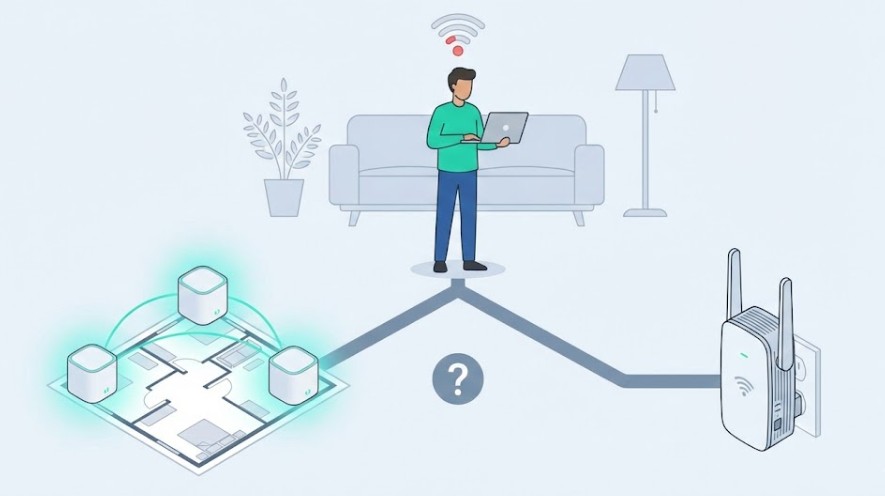

A poor or inconsistent WiFi signal can grind your productivity to a standstill, especially when that laptop simply will not stay connected in the corners of your home. If your Wi-Fi just won’t reach far enough, you’ve got two popular solutions: a mesh Wi-Fi system or a Wi-Fi range extender. One will give you more coverage, but they work differently and each fits different needs. Understand how each option functions, and you’ll be well on your way to choosing the right upgrade for stronger, more reliable connectivity.
Determine What Type of Wi-Fi Problem You Have
Before you pick a solution, understand why your Wi-Fi is failing. Is your laptop dropping connection at a distance? Are speeds slowing dramatically once you’re out of the room with the router? Or do certain areas get no signal at all? By clarifying the problem-dead zones, weak coverage, or inconsistent bandwidth-you’ll know whether you need a system designed for whole-home connectivity or just a simple signal boost.
Discover how a mesh system fixes coverage gaps.
Mesh Wi-Fi systems use several satellite nodes placed around your home to form one network. Each node interacts with the others for fluent coverage of even bigger houses or multi-story layouts. If you move from one room to another, it automatically switches your device to the nearest node without losing the connection. For wide-scale dead zones or larger households, mesh systems offer the most reliable performance.
Compare extenders to understand their basic limitations.
Wi-Fi extenders take a different approach: they rebroadcast your existing router’s signal rather than creating one unified network. That can give you better coverage in a small area, but these extenders usually lower speeds because they split bandwidth between your device and the main router. They work best when trying to get around minor blind spots or extend coverage to one additional room, but aren’t ideal for consistent high-speed use around the home.
Assess the Home Layout before Selecting Wi-Fi Upgrades
The size of your home, the structure, and wall material make a big difference in your Wi-Fi strength. Large houses, thick concrete walls, and multi-floor setups are usually too much for a single router to handle; for these, mesh systems are the best option. Smaller apartments or studios with only one weak zone may be adequately helped by a range extender without needing a full network replacement. Match the upgrade to your environment for the best results.
Consider Device Demands for Stronger Network Performance
Other factors include the number of devices in your household. Smart home gadgets, work laptops, gaming consoles, and streaming devices eat up bandwidth. Mesh systems handle multiple devices smoothly, allowing for high speeds throughout the home. Extenders may struggle with heavy loads or high-definition streaming. Always factor in how much your network needs to support before making a decision.
Decide Based on Speed, Budget, and Long-Term Needs
Mesh systems are much more powerful, but cost a lot more money. Extenders are cheaper and easier to install but are best used as temporary solutions. If you foresee more devices or faster internet in the future, the long-term stability of a mesh setup is much better. But if all you need is just a quick fix for one spot, an extender may be sufficient.
Strong Connectivity Starts With The Right Solution It all depends on your space, devices, and expectations. Understand how each of these options will work to improve the coverage area. You’ll be able to eliminate weak spots while making sure your laptop always connects reliably.
News Source: PCmag.com
More Like This: Make Holiday Hosting Easier With a Smarter Guest Wi-Fi Setup






Leave a Reply