In an internet ecosystem dominated by data-driven profiling, DuckDuckGo (DDG) stands out as a privacy-focused search engine and browser ecosystem. Unlike traditional search engines whose business models rely on constructing persistent user profiles to target personalized advertisements, DuckDuckGo’s core engineering philosophy centers on zero-data retention and contextual querying.
Understanding how DuckDuckGo functions requires examining its underlying search aggregation pipelines, privacy engineering mechanisms, advertisement integration models, and client-side web browser protections.
1. Search Engine Architecture: Hybrid Aggregation
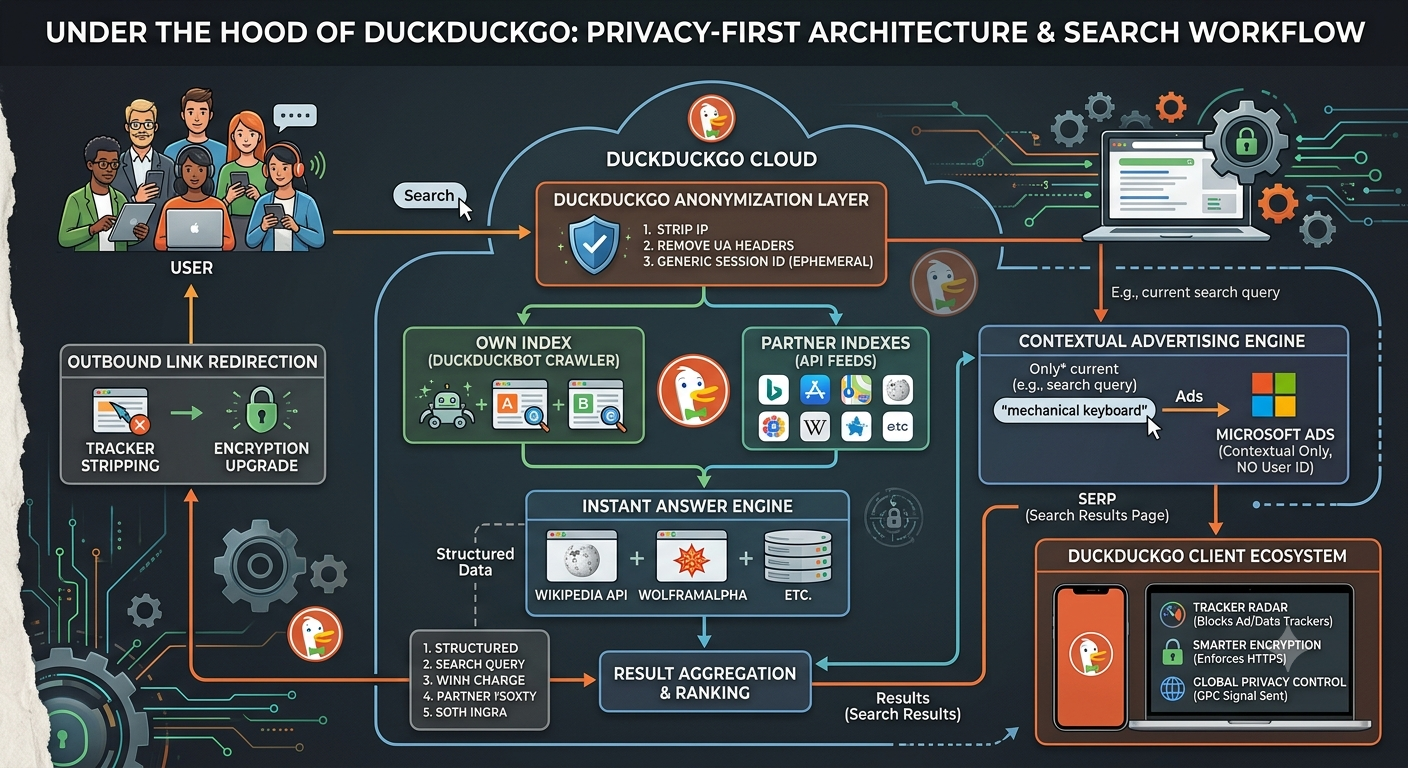
DuckDuckGo is primarily a hybrid search aggregator (sometimes classified as a metasearch engine), rather than an end-to-end web crawler. While companies like Google operate global Web Crawlers to build independent web indexes, DuckDuckGo combines its own proprietary web crawler with curated index feeds from over 400 partner sources.
                  +-----------------------------------+
                  |        User Search Query          |
                  +-----------------------------------+
                                    |
                                    v
                  +-----------------------------------+
                  |  DuckDuckGo Anonymization Layer   |
                  | (Strip IP, Headers, Session IDs)  |
                  +-----------------------------------+
                                    |
            +-----------------------+-----------------------+
            |                                               |
            v                                               v
+-----------------------+                       +-----------------------+
|  DuckDuckBot Index    |                       | Partner API Feeds     |
| (Proprietary Crawler) |                       | (Bing, Apple Maps,    |
|                       |                       |  Wikipedia, Trip)     |
+-----------------------+                       +-----------------------+
            |                                               |
            +-----------------------+-----------------------+
                                    |
                                    v
                  +-----------------------------------+
                  |   Instant Answer Engine & Parser  |
                  |     (Open Source Modules)         |
                  +-----------------------------------+
                                    |
                                    v
                  +-----------------------------------+
                  | Consolidated Search Results (SERP) |
                  +-----------------------------------+
Primary Components:
- DuckDuckBot: DuckDuckGo’s automated web crawler responsible for maintaining index freshness for targeted vertical searches, site icons, and site metadata.
- Partner Feeds: A vast majority of organic web index results are retrieved dynamically via partner APIs, most notably Microsoft Bing, along with specialized datasets from sources like Apple Maps (for geocoding and local search), Wikipedia, and WolframAlpha.
- Instant Answer Infrastructure: Structured information blocks displayed at the top of the Search Engine Results Page (SERP) are driven by open-source modules parsing static datasets, specialized web endpoints, and structured API responses.
2. Privacy Engineering Mechanics
The defining feature of DuckDuckGo is its privacy architecture. Most privacy leakage occurs during three key phases: Query Transmission, Session Tracking, and Outbound Link Redirection.
A. Anonymized Query Routing & Anti-Tracking
When a user submits a query on standard search engines, the server logs the user’s IP address, User-Agent header, search terms, and timestamp, associating them with a persistent cookie ID.
DuckDuckGo eliminates this trail through server-side request stripping:
- IP Address Abstraction: Incoming HTTP requests pass through proxy servers where the client’s public IP address is discarded from server logs before query execution.
- Header Sanitization: Request headers containing identifying metadata (such as device configurations or unique browser signatures) are truncated or standardized.
- Zero Session Storage: Queries are processed ephemerally in memory. No server-side database links sequential queries from the same device session.
B. Prevention of Search Leakage
Search leakage occurs when a user clicks a search result link, and the target website receives the user’s exact search query via the HTTP Referer header.
DuckDuckGo mitigates search leakage using HTTP Referrer Restrictions and Redirect Wrapping:
- By default, search results use strict HTTP
Referrer-Policysettings (originorno-referrer). - Links route through an internal proxy mechanism (
[duckduckgo.com/l/?uddg=](https://duckduckgo.com/l/?uddg=)...) that strips the raw query parameters before redirecting the client browser to the external destination URL.
3. Monetization Without Profiling
Traditional search engines optimize monetization via Behavioral Targeting—recording a user’s cross-site browsing history to infer interests, demographic attributes, and purchase intent. DuckDuckGo utilizes Contextual Advertising.
| Feature | Behavioral Advertising (Traditional) | Contextual Advertising (DuckDuckGo) |
| Data Source | Browsing history, IP tracking, user profiles | Current search query string only |
| Personalization | Tailored to individual user identity | Tailored exclusively to query context |
| Tracking Vectors | Cookies, device fingerprinting, account logins | None |
| Partner Network | Third-party ad-tech networks | Microsoft Advertising Network |
When a user searches for “mechanical keyboards”, DuckDuckGo requests ad inventory from partners (such as Microsoft Advertising) based solely on the string keyword "mechanical keyboards". No unique tracking identifier is passed to the ad vendor.
4. Client-Side Ecosystem & Browser Protections
Beyond its web search engine, DuckDuckGo provides standalone client applications and browser extensions (available on iOS, Android, macOS, and Windows) built on key technical modules:
Tracker Radar
DuckDuckGo maintains Tracker Radar, an automatically generated dataset built by continuously crawling the web in isolated browser instances. It identifies domain-level tracking behavior by analyzing:
- Third-party cookie creation.
- Canvas and WebGL API access for device fingerprinting.
- Known telemetry and tracking script patterns.
Smarter Encryption (HTTPS Enforcement)
DuckDuckGo maintains an automatically updated crawler-generated list of sites supporting HTTPS. The client browser automatically upgrades insecure http:// requests to encrypted https:// requests before transmitting data over the network, minimizing man-in-the-middle (MitM) exposure.
Global Privacy Control (GPC) Integration
DuckDuckGo client browsers embed Global Privacy Control (GPC) headers (Sec-GPC: 1) into HTTP requests automatically. This signals to websites that the user opts out of data selling or sharing under regulations such as the CCPA and GDPR.
Summary
DuckDuckGo demonstrates that modern search engines can deliver comprehensive results without compromise to individual privacy. By pairing a hybrid search architecture with server-side anonymization, referrer stripping, and contextual monetization, DuckDuckGo provides a robust, privacy-respecting alternative to conventional profiling-driven search platforms.
Also Read: The Evolution of the Modern Trail: A Deep Dive into Spypoint Technology – My Tech Blaze