Modern endpoint security relies heavily on massive agent footprints, dense local databases, and heavy background processes that consume significant CPU and RAM. HitmanPro, developed by Surfright and acquired by Sophos, takes a fundamentally different structural approach. Architected as a specialized “second-opinion” malware removal utility, it operates as a lightweight tool designed to run alongside active primary antivirus products without causing software conflicts or kernel-level panics.
Binary Design and Zero-Installation Architecture
The core executable of HitmanPro is roughly 10 megabytes in size, containing compiled x86/x64 assembly optimized for immediate execution. One of the most critical aspects of its binary design is its ability to operate in a “No Installation Mode”.
When launched in this mode, the program does not register standard Windows installer keys, populate the %ProgramFiles% directory, or drop persistent services into the Service Control Manager (SCM). Instead, it runs entirely out of user-space memory or volatile system directories. This makes it highly portable, allowing incident responders and system administrators to deploy the executable directly via USB drives, network shares, or automated command-line scripts.
Because it does not utilize traditional real-time hooks in its basic iteration, HitmanPro avoids driver-level conflicts with pre-installed Endpoint Detection and Response (EDR) agents or third-party firewalls. It treats the operating system as a static landscape during its execution loop, mapping active processes, memory spaces, and system hives without needing to establish long-term persistence or monitor active file system events through a mini-filter driver.
The Cloud-Assisted Scan Loop
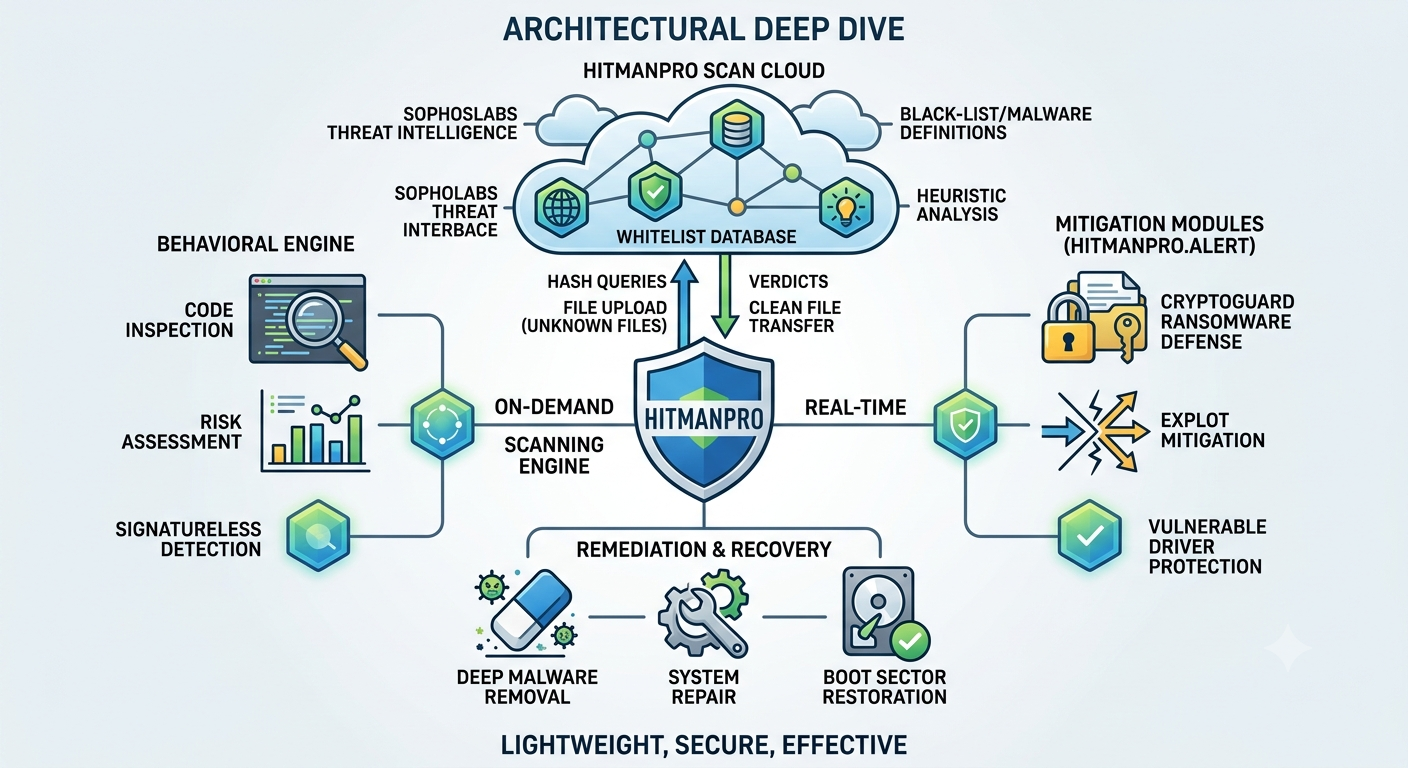
HitmanPro addresses the limitation of local signature databases by implementing a multi-engine, cloud-assisted scanning framework. A typical signature-based antivirus requires hundreds of megabytes of definitions stored locally to match file hashes. HitmanPro offloads this entire computational layer to its proprietary “Scan Cloud”.
The application workflow proceeds through a distinct multi-stage verification loop:
1. Telemetry Collection
When a scan is initiated, the engine crawls critical system sectors, focusing on active volatile memory, auto-start entries (Run keys, scheduled tasks, WMI event consumers), and OS binary paths.
2. Behavioral Profiling
Instead of checking every file against a static hash list immediately, HitmanPro analyzes the metadata and behavior of executable objects. If a file displays anomalous characteristics—such as lacking a valid digital signature, utilizing known packaging wrappers, or launching from an unconventional directory—it is flagged for closer examination.
3. Hash Querying
For all flagged or suspicious objects, HitmanPro calculates cryptographic hashes (typically SHA-256) locally. It sends a payload of these hashes over a secure HTTPS connection to the HitmanPro Scan Cloud. The cloud infrastructure queries a consolidated ecosystem backed by multiple security research centers, including SophosLabs.
4. Verification and Classification
If a hash matches a known-safe whitelist database, it is cleared immediately. If it matches a known-bad blacklist, a remediation instruction is passed back down to the agent. If the hash is completely unknown, the file is flagged for dynamic cloud uploading, where it undergoes deep static and automated analysis before a verdict is returned.
Advanced Behavioral Analysis and Exploit Mitigation
While the standard HitmanPro engine is built for on-demand scanning and remediation, the premium module—HitmanPro.Alert—adds an active, kernel-level prevention driver (hmpalert.sys). This module implements real-time exploit mitigation and signatureless protection against zero-day exploits and evasion tactics.
CryptoGuard Defense
A major component of HitmanPro.Alert is the CryptoGuard engine, designed to counteract ransomware operations. Rather than looking for specific ransomware payloads, CryptoGuard monitors the file system for rapid, unauthorized file encryption processes. When an untrusted process attempts to overwrite user data files with encrypted strings, CryptoGuard intercepts the I/O request packets (IRPs), halts the offending thread, and leverages a hidden file-caching mechanism to automatically roll back the targeted files to their pre-encrypted states.
Advanced Process Mitigations
HitmanPro.Alert actively hardens user-space applications (such as web browsers, office suites, and media players) against memory exploitation techniques. The engine implements signatureless protections targeting specific adversarial behaviors recorded in frameworks like MITRE ATT&CK:
- StackPivot Mitigation: Detects when an exploit attempts to redirect the CPU’s stack pointer to an area of memory controlled by the attacker, effectively defeating Return-Oriented Programming (ROP) attack chains.
- HollowProcess & PEB Protection: Monitored processes are shielded against process hollowing, where malicious code overwrites the legitimate code inside a suspended host process. The system continuously validates the integrity of the Process Environment Block (PEB).
- Vulnerable Driver Guard: Added to mitigate Bring Your Own Vulnerable Driver (BYOVD) tactics. It prevents attackers from installing legally signed but security-compromised kernel drivers to disable EDR agents or tamper with system memory.
Deep Remediation and Boot-Record Restoration
When a threat is confirmed, HitmanPro executes a deep remediation sequence. Many sophisticated threat variants drop persistent rootkits, modify the Master Boot Record (MBR), or tamper with GUID Partition Tables (GPT) to maintain persistent access before the operating system completely loads.
HitmanPro bypasses standard Windows API restrictions by interacting with raw disk sectors. It can inspect and repair corrupted boot sectors, neutralizing rootkits and bootkits directly. During the remediation phase, the tool replaces infected system components with clean, native versions of Windows files stored in its cloud database, restoring system settings to their default, uninfected states without requiring a full OS reinstallation.
Technical Summary
HitmanPro provides an optimized approach to system remediation and proactive endpoint hardening. By decoupling resource-heavy signature databases from the local host, it maintains an agile, 10-megabyte footprint that can run seamlessly alongside primary corporate defenses.
Whether utilized as an on-demand, no-installation utility for active incident response or extended via HitmanPro.Alert’s behavioral exploit mitigations, the software provides a highly focused layer of system defense. Its reliance on cloud heuristics, dynamic file rollback, and hardware-level process protection ensures robust mitigation against modern, rapidly evolving malware campaigns.
Also Read: Carbonite Automated Backup Service for Effortless Data Protection – My Tech Blaze