In an era defined by unconventional warfare, cyber threats, economic manipulation, and disinformation campaigns, the traditional definition of national defense is no longer sufficient. Military might alone cannot guarantee a nation’s sovereignty or stability. To navigate this complex, gray-zone security landscape, modern states rely on Total Defense—a holistic, society-wide framework that mobilizes every sector of a nation to deter threats and recover from crises.
Total Defense is built on a simple yet profound premise: security is not the sole responsibility of the armed forces; it is the collective duty of every citizen, business, and institution.
The Historical Genesis and Evolution
While the concept of mobilizing an entire society during wartime dates back centuries, the formalized framework of Total Defense emerged during the Cold War. Nordic countries, most notably Sweden and Switzerland, pioneered the model to counter the overwhelming conventional threat of the Soviet Union. Recognizing they could not match the superpowers in sheer numbers, these nations weaponized their societal resilience.
In the 21st century, the concept has evolved drastically. Today’s threats are often asymmetric, hybrid, and non-linear. The battlefield has expanded from physical borders to digital infrastructure, financial systems, and public psychology. As a result, contemporary Total Defense models—famously exemplified by nations like Singapore and Taiwan—are designed to counter everything from pandemics and supply chain disruptions to coordinated cyberattacks and state-sponsored fake news.
The Core Pillars of Total Defense
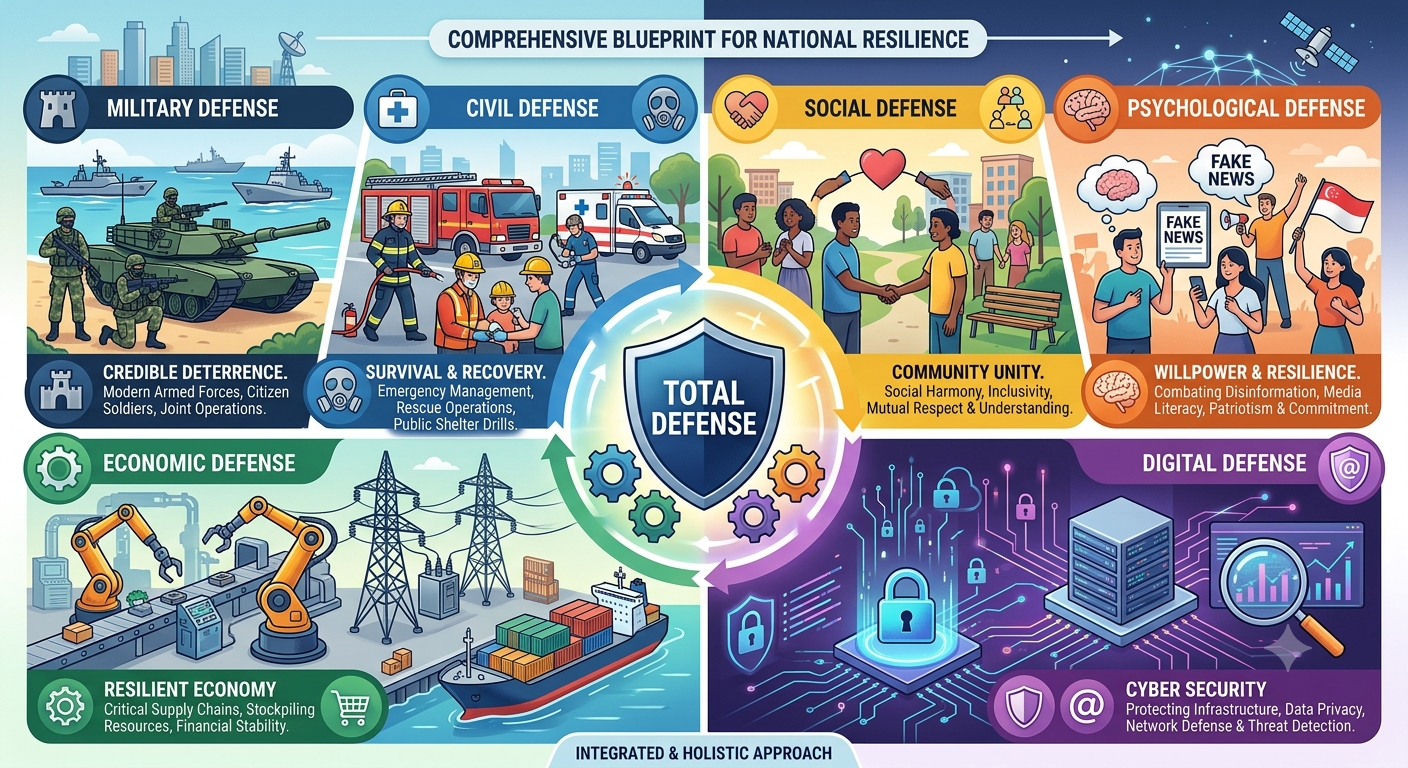
A robust Total Defense strategy typically spans six interconnected pillars. Each acts as a vital organ in the national body, ensuring that a shock to one area does not collapse the entire system.
1. Military Defense
The bedrock of national sovereignty remains a capable, technologically advanced military. Military Defense focuses on maintaining a credible deterrent force. Beyond regular armed forces, this pillar heavily emphasizes the readiness of citizen-soldiers (reservists) and civilian-military cooperation. The goal is to make the cost of aggression prohibitively high for any adversary.
2. Civil Defense
When a crisis strikes—whether a missile strike, an earthquake, or a hazardous chemical spill—Civil Defense ensures the population can survive and recover. This involves training civilians in first aid, establishing robust evacuation and shelter protocols, and maintaining emergency services. Civil Defense transforms ordinary citizens from helpless bystanders into active first responders.
3. Economic Defense
Modern conflicts are frequently fought in the financial and commercial arenas. Economic Defense is about securing a nation’s financial stability and ensuring supply chain resilience. It involves stockpiling critical resources (food, medicine, fuel), diversifying trade partnerships, and safeguarding critical infrastructure like power grids and water supplies against sabotage. A nation that cannot feed its people or power its hospitals during a blockade cannot defend itself.
4. Social Defense
A nation is only as strong as its social fabric. Social Defense focuses on maintaining harmony, trust, and unity across different ethnic, religious, and socioeconomic groups. Adversaries often exploit existing societal fault lines to sow discord and weaken a country from within. By fostering inclusivity, civic pride, and mutual respect, Social Defense ensures that the population remains united during times of intense pressure.
5. Psychological Defense
Perhaps the most critical battlefield of the 21st century is the human mind. Psychological Defense is a population’s collective resilience against disinformation, propaganda, and psychological warfare. It involves media literacy programs, transparent government communication, and an ingrained public willpower to defend the nation’s way of life. If an adversary destroys a population’s will to fight, the military becomes irrelevant.
6. Digital Defense (The Modern Frontier)
As societies become hyper-connected, Digital Defense has emerged as a distinct, vital pillar. It encompasses cybersecurity protocols to protect national databases, banking systems, and communications infrastructure from state-sponsored hackers. It also involves educating citizens on cyber hygiene to prevent widespread digital disruptions.
Why Total Defense Matters Today: The Hybrid Threat
The necessity of Total Defense is driven by the rise of hybrid warfare—the blending of conventional military force with unconventional tools such as cyberattacks, economic coercion, and electoral interference.
In hybrid warfare, lines are blurred:
- No Clear Beginning or End: Attacks happen continuously in peacetime without a formal declaration of war.
- Ambiguity: Attributions are difficult, as cyberattacks or disinformation campaigns can be executed via proxies.
- Targeting Civilians: The ultimate target is rarely a frontline trench; it is the civilian population’s trust in their institutions.
By implementing Total Defense, a nation eliminates “soft targets.” When a malicious actor realizes that a country’s cyber defenses are airtight, its supply chains are backed up, its people are immune to fake news, and its citizens are trained to assist emergency services, the psychological leverage of hybrid warfare evaporates.
Implementation: Turning Strategy into Culture
Total Defense cannot simply be a policy paper gathering dust in a government archive; it must be a living, breathing part of national culture. Successful implementation requires:
- Public Education and Drills: Regular, nationwide drills—such as testing siren networks, simulating cyber blackouts, or practicing food rationing—keep the public sharp and prepared.
- Public-Private Partnerships: Governments must collaborate with private corporations, as businesses own the vast majority of critical infrastructure (telecoms, logistics, energy).
- Individual Responsibility: Every citizen must know their role, whether it is serving in the military, volunteering for civil defense, or simply verifying information before sharing it online.
Conclusion: The Ultimate Deterrent
Ultimately, Total Defense is the ultimate form of deterrence. It sends a clear, powerful message to any potential aggressor: To defeat us, you cannot simply defeat our army. You must defeat our teachers, our engineers, our nurses, our businesses, and our entire population.
In an unpredictable world, true security does not come from isolating behind high walls or relying entirely on high-tech weaponry. It comes from the shared resilience, adaptability, and unbreakable resolve of an entire society standing as one.
Also Read: Breezelin: Redefining the Modern Workplace – My Tech Blaze