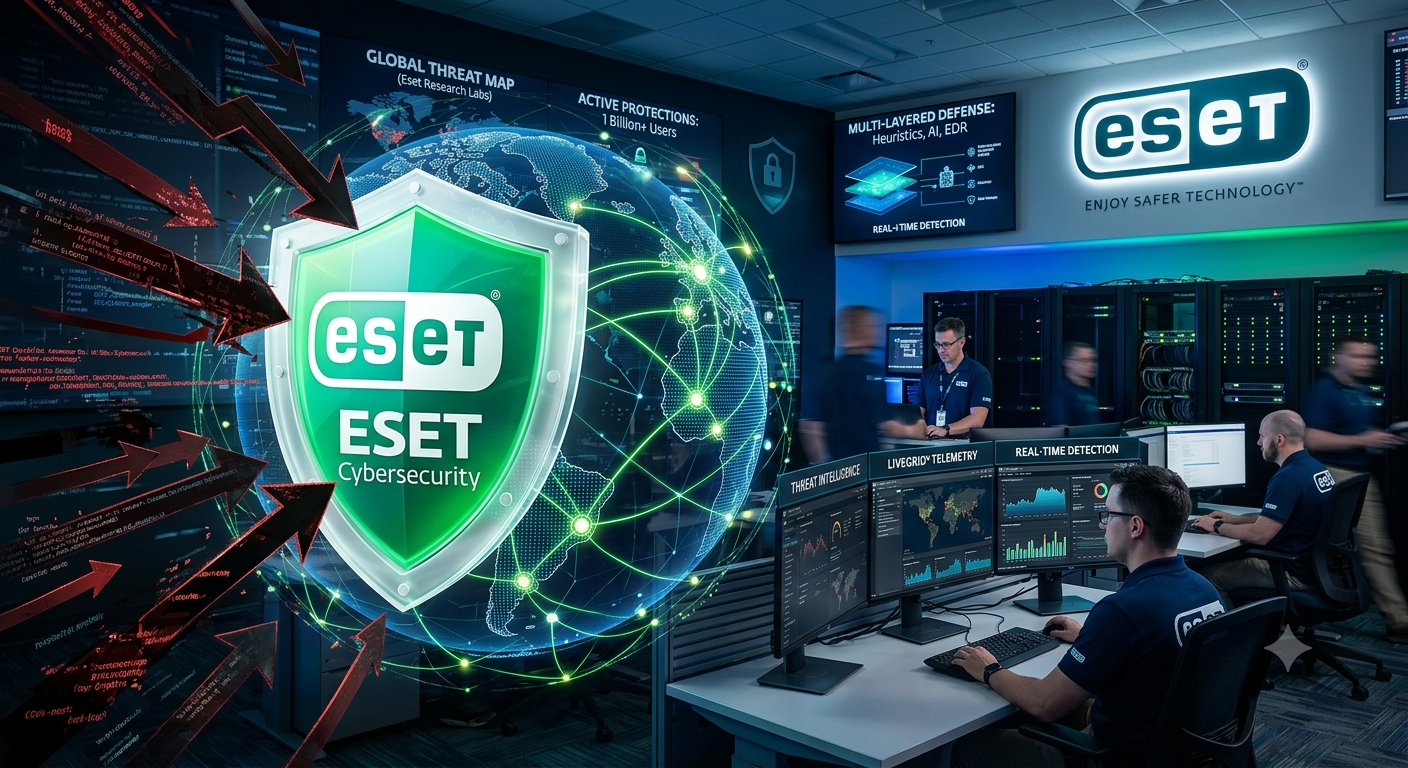
In the fast-evolving landscape of global cybersecurity, few companies boast the longevity, technical consistency, and architectural elegance of ESET. Founded in 1992 and headquartered in Bratislava, Slovakia, ESET has grown from a pioneering local utility into Europe’s largest privately held cybersecurity firm, protecting over one billion internet users across consumer and enterprise markets.
The story of ESET is a masterclass in how proactive engineering, an uncompromising focus on system performance, and cutting-edge threat research can build an enduring global empire.
The Origins: “Hospital at the End of the Disk”
The roots of ESET trace back to 1987, a time when personal computers were entering mainstream offices and the very concept of a “computer virus” was a novel threat. Two young Slovak programmers, Miroslav Trnka and Peter Paško, discovered one of the world’s earliest wild computer strains, the “Vienna” virus. Realizing the destructive potential of this unchecked code, they wrote a universal cleaning utility to neutralize it.
They named their creation NOD, an acronym for Nemocnica na Okraji Disku (“Hospital at the End of the Disk”). This was a playful, local pun on the popular Czechoslovak medical television drama Nemocnice na kraji města (“Hospital at the End of the City”).
Following the fall of the communist regime and the subsequent legalization of private entrepreneurship, Trnka and Paško teamed up with Rudolf Hrubý in 1992 to formally incorporate ESET. They named the company after Isis (specifically using the Slovak adaptation, Eset), the ancient Egyptian goddess of health, healing, and protection. When the computing world shifted to 32-bit architecture during the Windows 9x era, ESET completely rewrote its engine, birthing the legendary ESET NOD32 Antivirus.
Architectural Philosophy: The Light Footprint
While many competing security suites grew bloated over the decades—frequently slowing consumer PCs to a crawl and straining enterprise hardware—ESET chose a different engineering path. They prioritized a small system footprint.
By writing core engine components in highly optimized, low-level assembly language and C/C++, ESET maximized scanning speed while using minimal RAM and CPU resources. This approach made ESET incredibly popular among IT administrators, gamers, and businesses operating on tight hardware budgets.
This lean design philosophy is verified by ESET’s historic performance in industry benchmarks. The company holds the world record for consecutive VB100 Awards from Virus Bulletin, passing the milestone of 100 consecutive awards without missing a single in-the-wild threat, all while maintaining top performance scores in AV-Comparatives testing.
Technical Innovation: 16 Layers of Defense
ESET’s longevity is driven by its multi-layered approach to threat detection. The company was an early pioneer in moving away from reactive, signature-based scanning (which only catches known malware) toward advanced heuristics and machine learning.
[Inbound File/Code Execution]
         │
         ▼
 ┌───────────────┐
 │ Heuristic &   │ ──► Analyzes structure and "DNA" genes
 │ DNA Detection │
 └───────────────┘
         │
         ▼
 ┌───────────────┐
 │ Advanced Code │ ──► Emulates code execution inside an
 │   Emulation   │     isolated sandbox environment
 └───────────────┘
         │
         ▼
 ┌───────────────┐
 │ ESET LiveGrid │ ──► References global, cloud-powered
 │  Cloud Check  │     reputation and telemetry networks
 └───────────────┘
Rather than deploying these technologies as marketing buzzwords, ESET integrated neural networks into its scanning models as early as 1997. In 2005, it introduced DNA Detections, a system that extracts specific “genetic” characteristics of code. This allows the software to identify entirely new, modified mutations of malware based on their structural blueprint rather than waiting for an official signature update.
Key modern security layers include:
- Exploit Blocker: Monitors commonly abused software applications like web browsers, PDF readers, and email clients to stop attacks that try to bypass system patches.
- Ransomware Shield: A behavior-based layer that watches for unauthorized bulk file encryption, stepping in to block processes before they can lock user data.
- Advanced Memory Scanner: Directly intercepts heavily obfuscated or encrypted malware that attempts to inject itself straight into system RAM to hide from traditional disk scanners.
ESET’s Consumer and Business Ecosystem
To meet a diverse range of security demands, ESET separates its software suite into two core pillars: Home and Business.
For Home Users
The consumer portfolio focuses on effortless, comprehensive digital protection without distracting notifications. Organized under tiered frameworks like ESET HOME Security, options range from Essential (traditional NOD32 antivirus) to Premium and Ultimate tiers. These advanced packages provide a wide array of protective features:
- Safe Banking & Browsing: Isolates online banking and financial transactions within an ultra-secure browser extension to block keyloggers and form-grabbing scams.
- Smart Home & IoT Protection: Features a Network Inspector that audits home Wi-Fi routers, lists connected smart devices, and scans them for known firmware vulnerabilities.
- Privacy & Identity Tools: Includes an unlimited VPN, dark web data breach monitoring, and automated metadata removal from images uploaded online.
For Enterprise & Business Users
On the corporate side, ESET scales seamlessly from small businesses up to critical infrastructure networks. Managed via the unified, cloud-native ESET PROTECT console, enterprise defenses combine Extended Detection and Response (XDR), advanced cloud sandboxing, and full disk encryption. ESET serves as a vital gatekeeper across mail servers, mobile endpoints, gateway portals, and cloud office apps.
Global Threat Intelligence & Research
Beyond endpoint software, ESET is highly respected as an elite tier-one global threat intelligence hub. Operating research labs worldwide, its teams routinely discover and dismantle state-sponsored Advanced Persistent Threats (APTs) and massive criminal operations.
ESET researchers achieved critical historical breakthroughs by discovering Industroyer (the sophisticated malware that disrupted Kyiv’s power grid) and LoJax (the first real-world UEFI rootkit found in the wild capable of surviving a hard drive replacement).
Recognizing this expertise, global tech titans and law enforcement agencies heavily rely on ESET. The company is a prominent founding member of Google’s App Defense Alliance, actively scanning and securing the Google Play Store ecosystem. ESET also partners directly with Europol’s Cybercrime Centre and global task forces to systematically disrupt massive criminal botnets like Dorkbot, Gamarue, and Trickbot.
Looking to the Future: The Era of AI Security
As cybersecurity moves into an era dominated by artificial intelligence and automated exploitation, ESET remains a step ahead. Rather than simply using AI internally to catch malware, ESET builds active defenses designed to protect users from the unique risks of AI adoption.
The company’s latest endpoint security features shield complex enterprise workflows from “shadow AI” risks, prompt injections, and supply-chain vulnerabilities hidden within third-party AI libraries. By inspecting live browser-based AI prompts and outputs in real time, ESET blocks data leaks and malicious code generation right at the endpoint.
By combining over three decades of threat research with clean, high-performance software design, ESET continues to prove that effective digital security does not require sacrificing system performance. It remains a trusted, reliable guardian for individuals and enterprises maneuvering an increasingly complex digital world.
Source: Cyber Security Offering – All-in-one protection | ESET