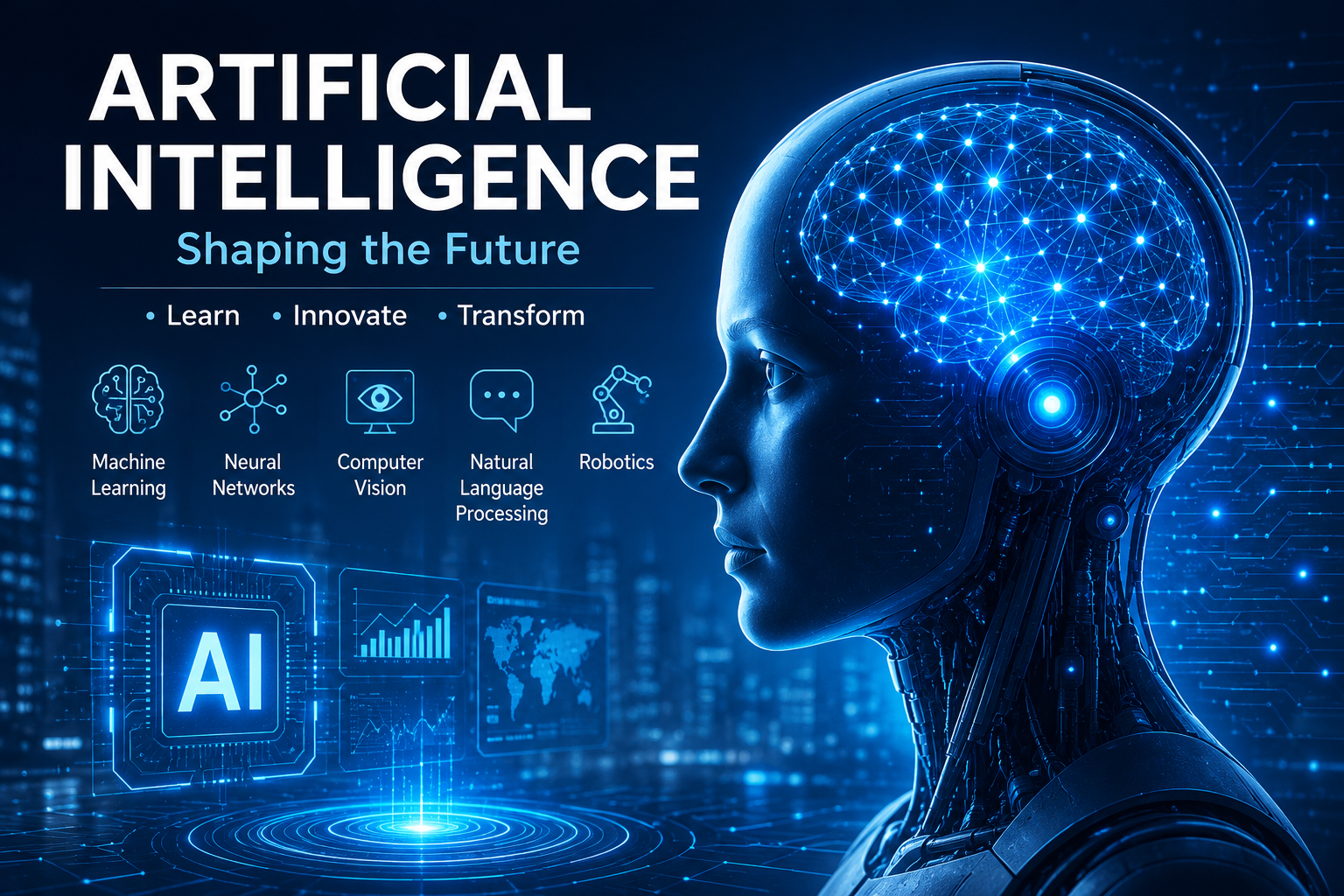
Introduction to Artificial Intelligence
We are currently living in the era of AI (Artificial Intelligence). It is a technology that enables machines to perform specific tasks. This technology is created by humans. It has evolved to handle various tasks, such as writing articles, generating images, writing code for websites, and creating portfolios. AI has become an integral part of daily life, utilized in smartphones, search engines, online shopping platforms, and numerous other digital services; as the technology advances, it continues to make tasks easier for people. At present, it is proving to be extremely useful.
What Is Artificial Intelligence
Artificial Intelligence is a part of computer science which deals in building such systems which are able to think, learn and decide. In contrast to the conventional programming where computer programs are designed to perform according to a pre-designed set of instructions, AI enables the computers to process large volumes of data, find out patterns and learn from the results for future.
How Artificial Intelligence Works
AI works by collecting and processing data. It uses algorithms and machine learning techniques to understand information and generate useful results.
Machine Learning
Machine learning is among the most significant components of AI. It enables computers to be able to learn from the data they receive and perform better without programming each specific case by humans. Machine learning is widely applied in recommendation engines, advertising, and fraud detection.
Deep Learning
Deep Learning is an advanced technique of machine learning which relies on artificial neural networks that imitate the human brain. The technique enables AI technologies to detect speech and language as well as recognize objects within images.
Applications of Artificial Intelligence
AI is applied in various sectors of society. In the healthcare sector, AI assists doctors in analyzing medical information to offer quality health care. In businesses, AI automates monotonous processes and improves customer service. AI is also integrated into education software to offer a personalized educational experience, while in navigational applications, it offers accurate directions.
Benefits of Artificial Intelligence
AI offers several benefits, including increased efficiency, improved accuracy, faster decision-making, and better customer experiences. It helps organizations save time, reduce costs, and make more informed decisions based on data.
Conclusion
Artificial Intelligence has brought about significant change in the modern world by making it possible for machines to learn, adapt and do complex tasks. In areas such as medicine, business, transport and learning institutions, artificial intelligence brings about new possibilities that improve the experience of people in their daily activities.