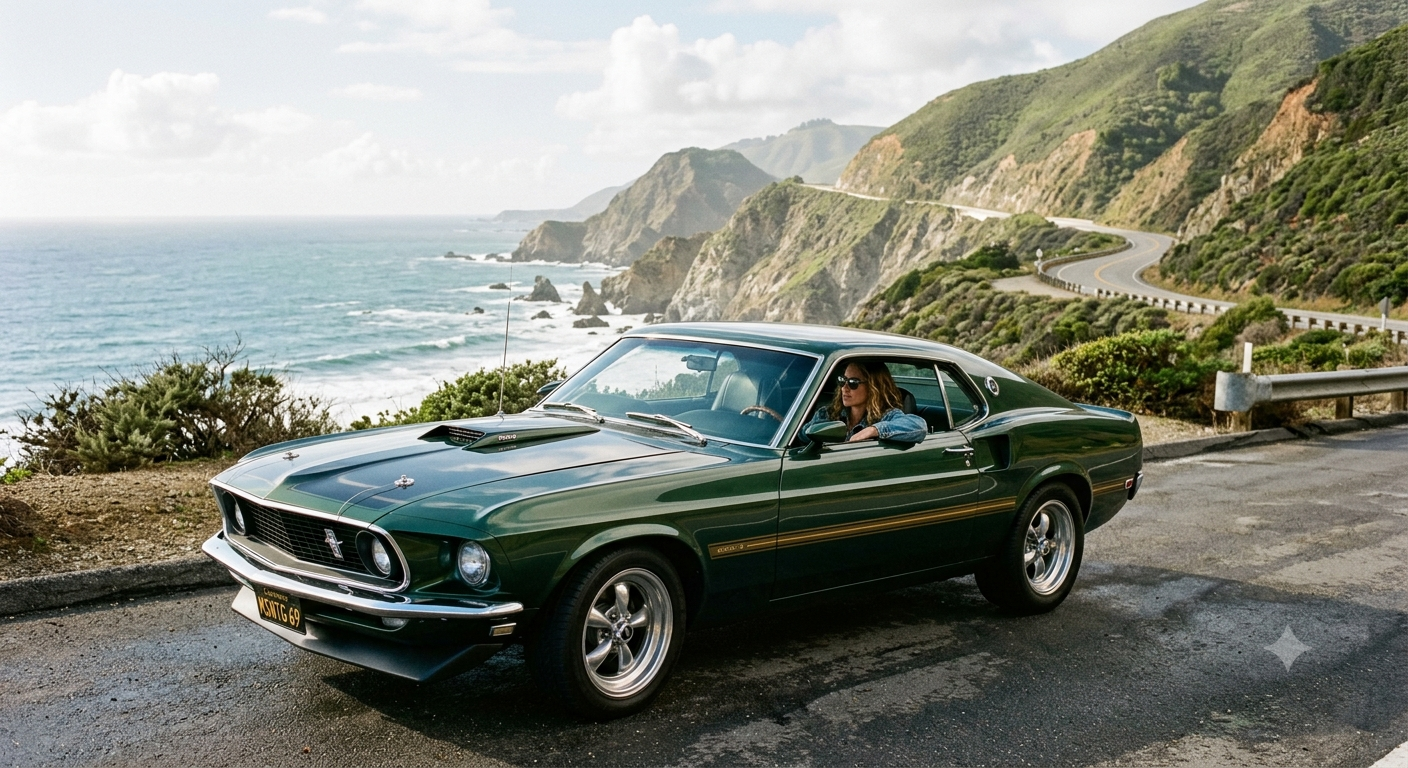
Few automobiles transcend the boundaries of mere transportation to become cultural phenomena. The Ford Mustang is one of them. For over six decades, this quintessential American machine has defined the concept of the “pony car,” capturing the spirit of freedom, performance, and affordable style. From its explosive debut in 1964 to its modern iterations as a high-tech track weapon and an all-electric SUV, the Mustang remains an enduring symbol of automotive passion.
1. The Birth of a Revolution (1964–1973)
In the early 1960s, Ford executive Lee Iacocca envisioned a vehicle tailored to the burgeoning, youthful Baby Boomer generation. They wanted something sporty, distinctive, and crucially, inexpensive.
On April 17, 1964, Ford introduced the Mustang at the New York World’s Fair. The response was unprecedented. Ford projected annual sales of roughly 100,000 units; instead, dealerships were overwhelmed, and Ford sold over 400,000 Mustangs in its first year alone. Within two years, the one-millionth Mustang rolled off the assembly line.
Key Highlights of the First Generation:
- The “1964½” Myth: Though officially titled 1965 models, the earliest production run is affectionately dubbed the 1964½ by enthusiasts due to its mid-year launch.
- The Shelby Connection: Looking to give the Mustang serious racing credentials, Ford partnered with legendary racer Carroll Shelby. The resulting 1965 Shelby GT350 cemented the Mustang’s status as a genuine performance car.
- The Hollywood Debut: In 1968, Steve McQueen drove a Highland Green Mustang GT Fastback through the streets of San Francisco in Bullitt, creating arguably the most famous car chase scene in cinema history.
As the 1970s approached, the Mustang grew larger and heavier, culminating in powerful big-block V8 variants like the Mach 1 and Boss 429, which dominated the drag strips of the era.
2. Evolution Through Adversity (1974–1993)
The automotive landscape shifted dramatically in 1973 due to the global oil crisis and tightening emissions regulations. Ford had to pivot quickly.
The Mustang II (1974–1978)
Smaller, lighter, and based on the Ford Pinto platform, the Mustang II is often criticized by modern performance purists for its lack of horsepower. However, it was exactly what the market needed at the time. It was a massive commercial success, winning Motor Trend’s Car of the Year in 1974 and keeping the nameplate alive when many muscle cars were going extinct.
The Fox Body Era (1979–1993)
In 1979, Ford introduced the third-generation Mustang built on the versatile Fox platform. This era marked a massive return to form for performance enthusiasts. Lightweight and highly customizable, the Fox Body Mustang—especially the 5.0-liter V8 models—became a favorite for drag racers, street tuners, and law enforcement agencies alike. It brought a blocky, distinctly ’80s aesthetic that remains highly collectible today.
3. The Modern Retro Renaissance (1994–2014)
The SN95 and New Edge (1994–2004)
The fourth-generation (SN95) brought a major aerodynamic redesign, sweeping away the straight edges of the Fox Body in favor of softer, organic curves. In 1999, the “New Edge” design language sharpened these curves into crisp, aggressive lines. This generation saw the introduction of the modular 4.6-liter V8 and the legendary 2003–2004 SVT Cobra, nicknamed “The Terminator” due to its supercharged, iron-block power.
The S197: Retro-Futurism (2005–2014)
In 2005, Ford struck gold by looking backward. The S197 generation introduced a “retro-futuristic” design that heavily channeled the styling cues of the fastback Mustangs from the late 1960s. Boasting a bold stance, round headlights, and a fastback profile, it kicked off a retro muscle car war in Detroit, prompting Chevrolet and Dodge to revive the Camaro and Challenger.
4. Going Global: The S550 and S650 Generations (2015–Present)
With the introduction of the sixth generation (S550) in 2015, Ford transformed the Mustang from an American specialty into a global sports car. For the first time, it featured an independent rear suspension (IRS) across all trims, drastically improving handling, and was manufactured in right-hand-drive configurations for international markets like the UK, Australia, and Japan.
The Seventh Generation (S650)
Launched for the 2024 model year, the S650 generation represents a bold bridge between digital innovation and traditional internal combustion power. While competitors like the Chevrolet Camaro and Dodge Challenger phased out their traditional V8 layouts, Ford doubled down, retaining a naturally aspirated 5.0-liter Coyote V8.
The interior underwent a radical transformation, featuring an immersive, fighter-jet-inspired dual-screen cockpit utilizing the Unreal Engine for crisp graphics. It also introduced the Dark Horse, the first new continuous performance nameplate for the brand in decades, designed specifically for track use.
5. Expanding the Moniker: The Mustang Mach-E
In 2021, Ford made a decision that sparked fierce debate across the automotive world: they applied the Mustang name to an all-electric, four-door crossover SUV—the Mustang Mach-E.
While purists initially balked, the Mach-E proved itself by delivering blistering acceleration, sharp handling, and a distinct design language that paid homage to its coupe sibling. It signaled Ford’s vision for the future, proving that the spirit of the Mustang—performance, style, and innovation—could thrive in an electrified era.
Summary of the Mustang’s Evolution
| Generation | Era | Defining Characteristic | Notable Model |
| 1st Gen | 1964–1973 | The Original Pony Car | 1965 Shelby GT350 |
| 2nd Gen | 1974–1978 | Compact & Fuel Efficient | Mustang II King Cobra |
| 3rd Gen | 1979–1993 | The Fox Body Era | 1987 Mustang GT 5.0 |
| 4th Gen | 1994–2004 | Aerodynamic & “New Edge” | 2003 SVT “Terminator” Cobra |
| 5th Gen | 2005–2014 | Retro-Futuristic Revival | 2012 Boss 302 |
| 6th Gen | 2015–2023 | Global Reach & Independent Rear Suspension | Shelby GT500 |
| 7th Gen | 2024–Present | Digital Cockpit & Refined V8 Power | Mustang Dark Horse |
The Legacy of the Wild Horse
The Ford Mustang is more than a combination of steel, rubber, and glass. It is a cultural touchstone that has starred in thousands of movies, inspired countless songs, and populated the driveways of millions of people worldwide. It democratized performance, bringing the thrill of a sports car to everyday drivers.
Whether it is the rumble of a classic V8, the turbo-whine of an EcoBoost, or the silent acceleration of the Mach-E, the Mustang continues to represent the thrill of the open road and the unyielding spirit of American automotive innovation.
Also Read:The Ultimate Guide to Modern Cybersecurity: Demystifying Malwarebytes – My Tech Blaze
Source:2026 Ford Mustang® | Pricing, Photos, Specs & More | Ford.com